Reasoning · Avg. Pass@1
+11.6 pp
Largest gain on Semi-AR MDMs
On SDAR-8B-Chat (K=2), Info-Gain pushes average accuracy from 45.1% (LookUM) to 55.8%, an absolute +10.7 pp over the strongest concurrent lookahead baseline.
1Tsinghua University · 2Singapore Management University · 3Shanghai Jiao Tong University · 4Beihang University
Masked Diffusion Models (MDMs) enable flexible decoding orders, yet existing samplers remain largely greedy, selecting locally certain tokens without accounting for their downstream effects. We show that this myopia can increase cumulative uncertainty and lead to suboptimal generation.
To address this, we propose the Info-Gain Sampler, a training-free decoding method that uses the bidirectional structure of MDMs to balance immediate uncertainty with the information gained over remaining masked positions. Across reasoning, coding, creative writing, and image generation tasks, Info-Gain Sampler consistently outperforms existing MDM samplers.
Five headline numbers from the paper.
On SDAR-8B-Chat (K=2), Info-Gain pushes average accuracy from 45.1% (LookUM) to 55.8%, an absolute +10.7 pp over the strongest concurrent lookahead baseline.
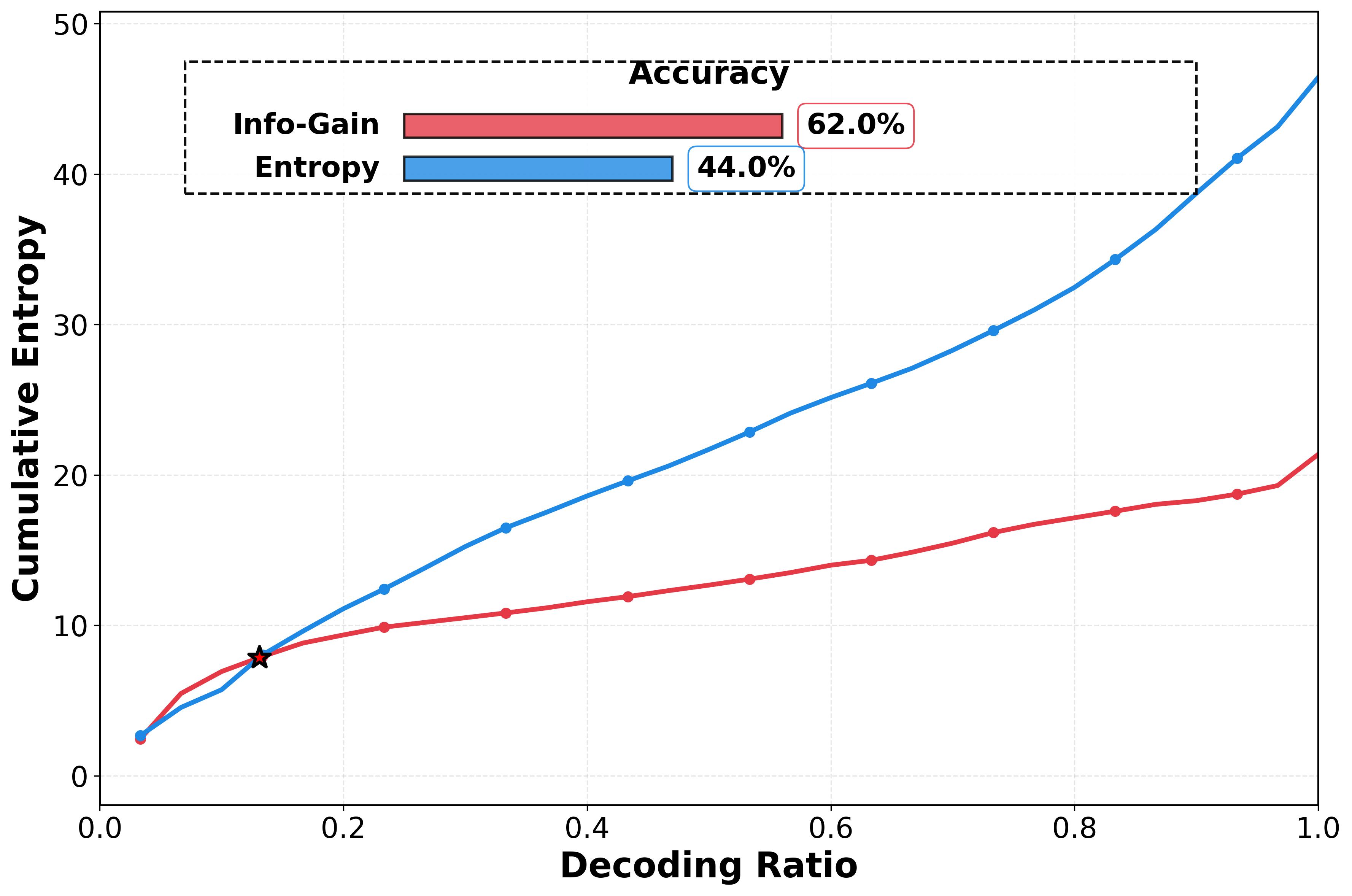
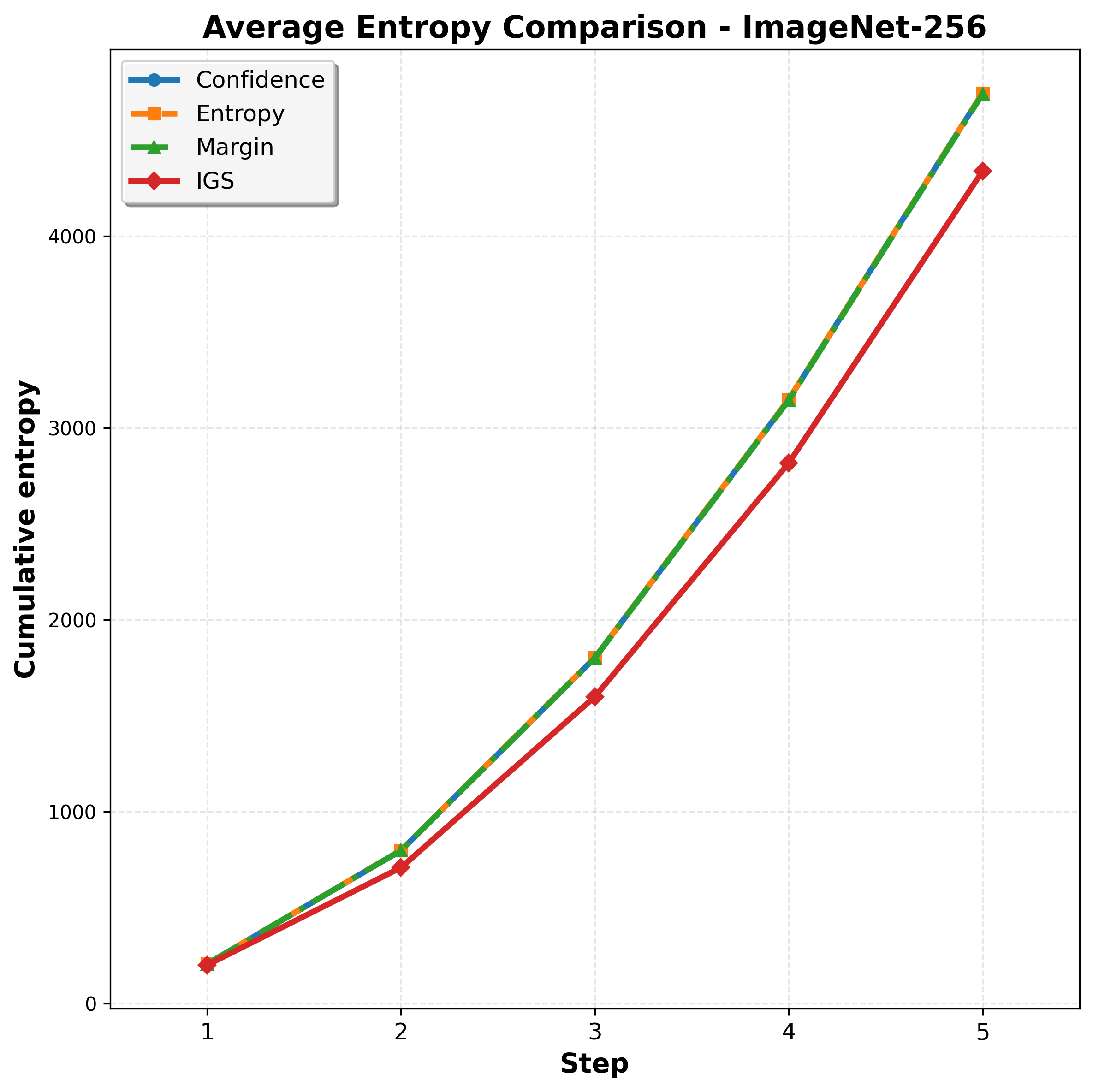
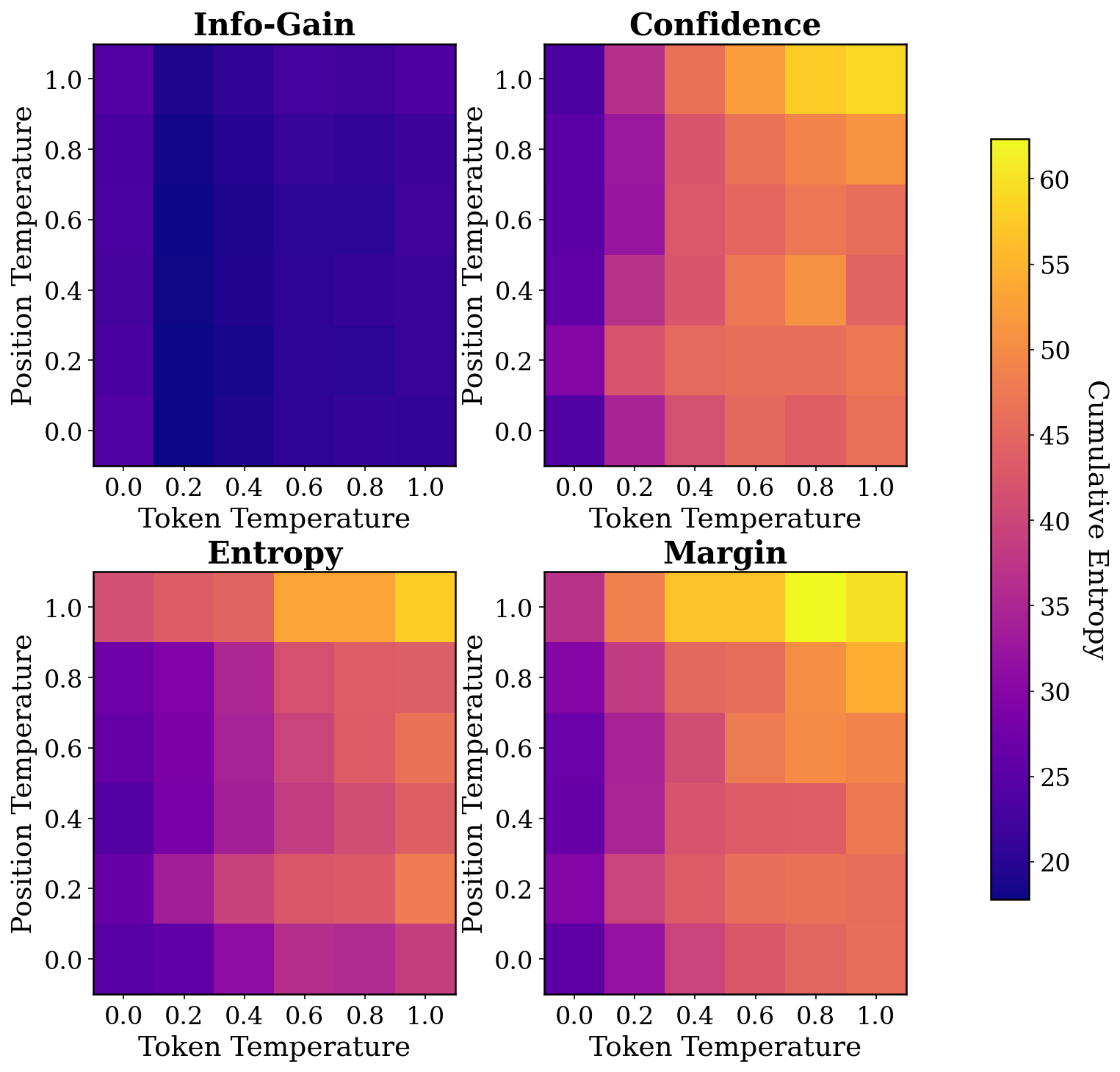
On reasoning tasks, cumulative entropy H̃ drops from 78.4 to
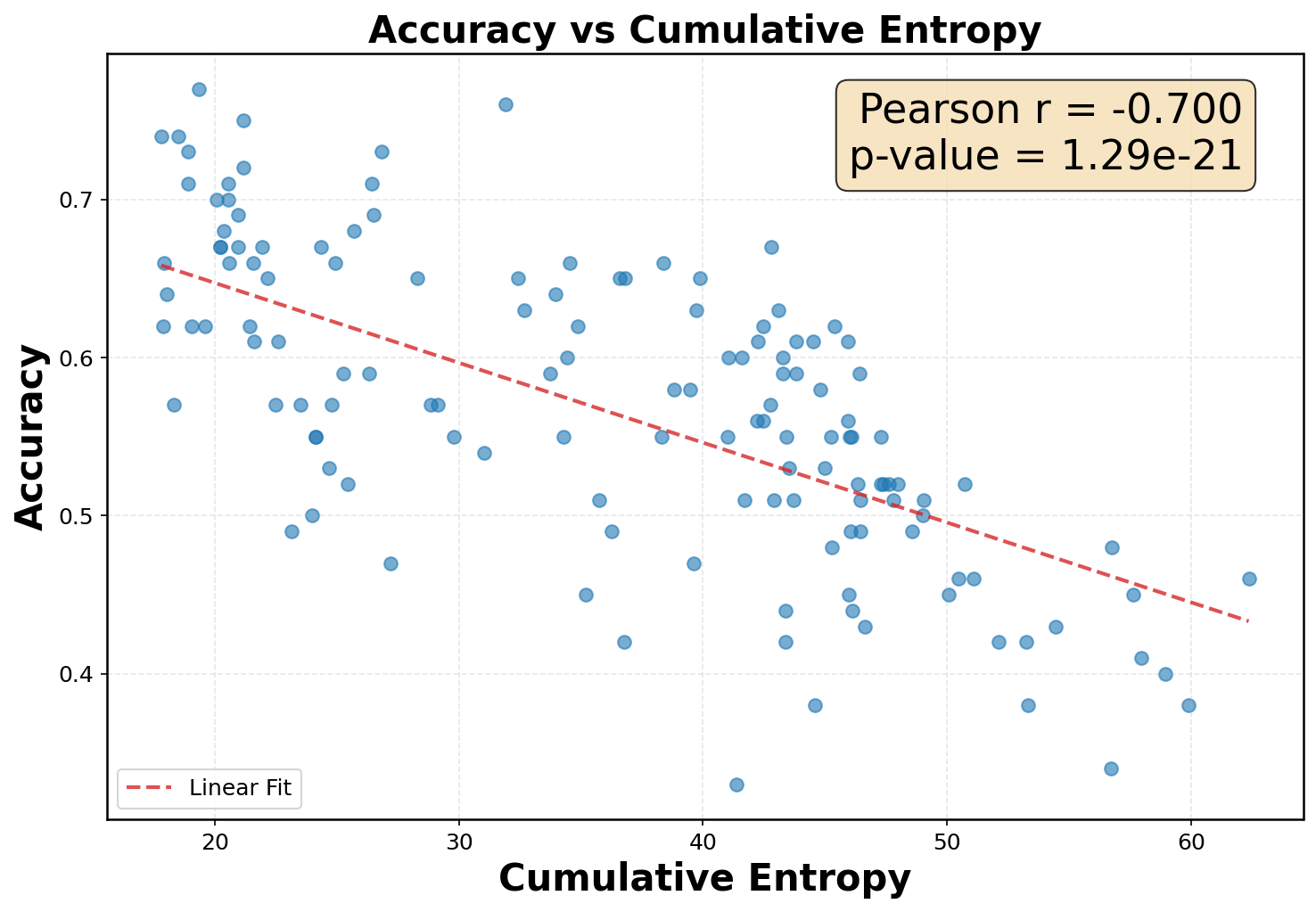
48.6 — only ~50% of the best greedy baseline. Lower H̃ correlates with higher accuracy
(Pearson r = −0.70).
Across temperatures and configs, Info-Gain wins 62.8% of head-to-heads on AlpacaEval, peaking at 80.3% against Entropy at high stochasticity (τ = 1.5).
On MMaDa with τ=0.4, Info-Gain raises GenEval avg. to 58.2 and improves ImageNet-512 FID by 5.2 points and IS by 9.7 points.
Acceleration via threshold γ = 0.8 keeps generation time within +24% and GPU
memory within +20% of greedy samplers — no extra training, no KV-cache surgery.
“Bidirectional attention lets MDMs look ahead. Greedy samplers throw that gift away. Info-Gain spends a tiny budget asking: which token, once revealed, makes the rest of the sequence easier?”
Score each candidate by immediate cost plus expected future information gain.
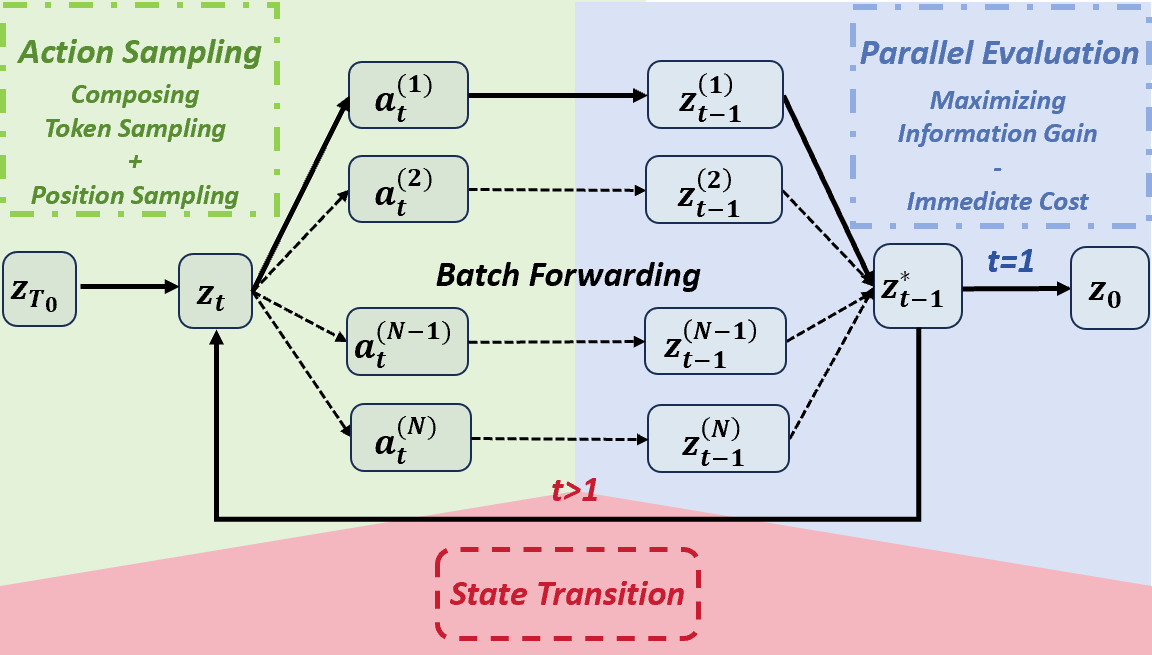
Confidence/Entropy/Margin samplers commit to the locally easiest token at every step. They never ask: “if I commit here, do the other masks become easier or harder?” In MDMs, where attention is bidirectional, that question is cheap to answer.
For each candidate decoding action a, score it by the reduction in expected uncertainty
over the remaining masked tokens after committing a. Combine this future term with the
usual immediate certainty term and pick the highest-scoring action.
Best in bold. All numbers from the paper.
SDAR-8B-Chat with block size 16, τtoken=0.7. H̃ = cumulative entropy (lower is better).
| K | Sampler | GSM8K | MATH500 | HumanEval | MBPP | Avg. ↑ | H̃ ↓ |
|---|---|---|---|---|---|---|---|
| 2 | Entropy | 42.2 | 24.4 | 26.2 | 20.6 | 28.4 | 238.6 |
| Confidence | 47.2 | 36.6 | 24.4 | 20.2 | 32.1 | 204.1 | |
| Margin | 45.2 | 22.4 | 19.5 | 19.8 | 26.7 | 230.9 | |
| KLASS | 50.4 | 32.3 | 30.7 | 26.6 | 35.0 | 210.3 | |
| LookUM | 75.3 | 44.9 | 28.2 | 31.8 | 45.1 | 103.2 | |
| Info-Gain | 82.7 | 54.6 | 46.3 | 39.4 | 55.8 | 74.1 | |
| 1 | Entropy | 68.8 | 44.6 | 37.8 | 49.0 | 34.9 | 120.4 |
| Confidence | 67.9 | 51.4 | 42.1 | 46.2 | 51.9 | 117.4 | |
| Margin | 65.3 | 40.2 | 32.3 | 43.2 | 45.3 | 138.2 | |
| KLASS | 69.9 | 42.3 | 45.7 | 46.6 | 51.1 | 105.3 | |
| LookUM | 80.3 | 60.0 | 38.2 | 39.8 | 54.6 | 53.7 | |
| Info-Gain | 87.9 | 61.8 | 62.2 | 53.0 | 66.2 | 41.0 |
τtoken=0.4, 50-step cosine scheduler.
| Method | Single ↑ | Two ↑ | Count ↑ | Color ↑ | Pos ↑ | Attr ↑ | Avg ↑ |
|---|---|---|---|---|---|---|---|
| Uniform | 94.1 | 66.7 | 38.4 | 78.2 | 19.0 | 28.8 | 54.2 |
| Entropy | 94.3 | 67.3 | 46.0 | 79.9 | 17.8 | 26.8 | 55.3 |
| Confidence | 93.8 | 69.7 | 46.3 | 81.9 | 16.0 | 27.0 | 56.0 |
| Margin | 94.0 | 68.7 | 47.3 | 80.1 | 19.0 | 29.0 | 56.3 |
| Info-Gain | 97.5 | 68.7 | 47.5 | 79.8 | 25.0 | 32.0 | 58.2 |
Length-controlled win-rate against three baselines on AlpacaEval (SDAR-8B-Chat).
| τ | K | vs Confidence | vs Entropy | vs Margin |
|---|---|---|---|---|
| 0.5 | 1 | 65.8 | 59.1 | 63.6 |
| 2 | 68.9 | 70.4 | 64.7 | |
| 1.0 | 1 | 57.7 | 60.1 | 55.2 |
| 2 | 61.1 | 65.7 | 57.5 | |
| 1.5 | 1 | 53.0 | 60.3 | 54.6 |
| 2 | 70.1 | 80.3 | 66.8 |
Why cumulative entropy is the right signal — and how Info-Gain reshapes the trajectory.
@inproceedings{yang2026improving,
  title     = {Improving Sampling for Masked Diffusion Models via Information Gain},
  author    = {Yang, Kaisen and Teoh, Jayden and Yang, Kaicheng
               and Zhang, Yitong and Lamb, Alex},
  booktitle = {Proceedings of the 43rd International Conference on Machine Learning},
  year      = {2026},
  url       = {https://arxiv.org/abs/2602.18176}
}